A longer connecting rod would probably help if the damn piston pin wasn't closer to the BOTTOM of the piston than the TOP!

That pipe looks nice enough to eat off of.... But you really can!
A longer connecting rod would probably help if the damn piston pin wasn't closer to the BOTTOM of the piston than the TOP!
The piston pin needs to be about half way up to skirt to distribute the load evenly on the skirt.
Also
Moving the piston pin will also require the cylinder to be located higher or lower affecting the crankcase volume.
One of the tricks in a good engine design is finding the happy medium in all of the design parameters simultaneously. If you optimize one parameter it often hurts another parameter so bad that the overall power and or reliability suffers.
What about using, say, a 5mm higher pin location, and a 5mm longer rod? My simple brain says "No moving cylinder" yeah?
That's fine its no big deal. You don't need to a prick about its only a pipe. Christ you act like someone is trying to bang your old lady.
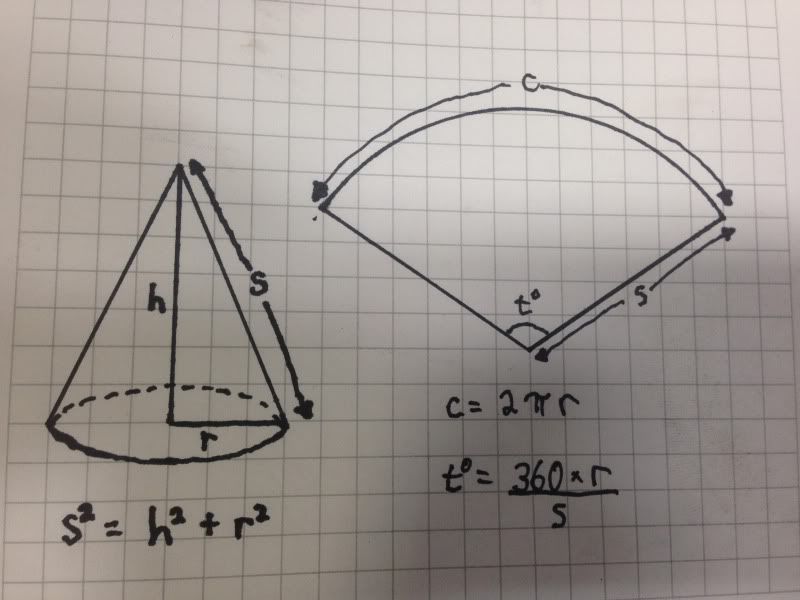
I didn't really think I was being a prick....I guess offering to help by posting up info on how to layout a cone is being a prick nowadays? All I was getting at is if you can't plug the numbers into these equations and solve for everything you need, then I'm not going to type out a big old math lesson. There are sights on the internet that can do a far better job than I can.
Also, I'm not giving out pipe dimensions. If I give out critical dimensions off of an HPR19 or Q pipe or any pipe for that matter, that is unethical. I'm not going to do that. I am not a pipe designer either, so I can't design a pipe for you and give you that info. I understand not wanting to shell out big bucks for a pipe, and the appeal of making your own. I have been there, but you are going to have to either design your own pipe, or buy one, or find someone else to give you the info. There are books out there that cover two stroke pipe tuning. I found a free copy of one on the internet once upon a time. It was very thorough, and made pretty good sense. I'm betting if you put your mind to it you could design a decent pipe with it.
Anyways I do appologize if I came across as a prick. I was tired and didn't feel like typing enough to thoroughly explain last night. I also needed to draw this diagram out to show how this worked.
10 hrs that's interesting.
I don't consider myself to have a high HP zilla but it seems to run pretty good and I'm getting 35 Hrs on average on a piston. JH would have a better idea of where my motors HP range would be.
Is your bike drag ported with no bridge?
10 hrs that's interesting.
I don't consider myself to have a high HP zilla but it seems to run pretty good and I'm getting 35 Hrs on average on a piston. JH would have a better idea of where my motors HP range would be.
Is your bike drag ported with no bridge?
One of my jugs, I ported excessively back in the day, and the bridge broke on it. I run it no bridge now, but my good jug has the bridge. It's funny, if you look at the two jugs most people would swear my old jug would have to run harder, but it isn't even in the same category as my new jug. The ports are much more hogged out in the old jug. But I made a couple of errors I can't correct completely in the transfer ports. It runs good on top, but is really dead down low. With my old jug I can run 30+ hours on a piston. When you pull the pistons out of it, they look worn, and the rings will be trashed, but the piston won't be collapsed much. With My new jug though, the piston looks good, with very little signs of wear, but it will be collapsed.
One of the most common porting errors I see on the LT500 is shops making the intake bridge narrow and or putting a knife edge on the bridge. Modifications like this just shows a lack of understanding of some of the most basic principles in gas dynamics. Narrowing the bridge just makes it weaker and knife edging actually makes the port act like the port is not as wide as it was before the knife edge shape was created.
It is very difficult to make someone understand why "Knife edging" does not do what seems like a no brainer. Unfortunately gas and fluid flow does not always behave like intuition would have us believe.
It's pretty much done at this point.
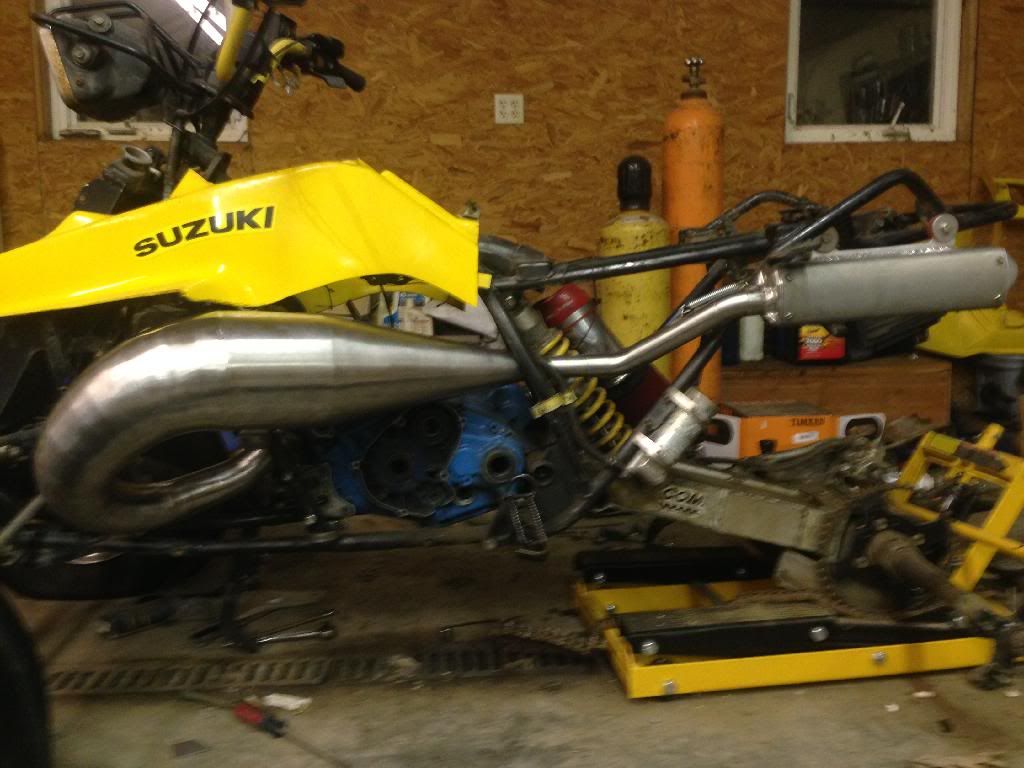
Nice
I've always hated using muratic acid to clean off my bare metal pipes.
I could go without 1 kidney to afford that

My next project is going to be my mustang. After I get it done, I'm going to finish my hybrid. After that I'm going to build myself an atv dyno. If I had a dyno where I could actually test and develop my own pipe, I might entertain building a few to sell, but knowing the speed at which I finish my projects it would be several years down the road at the soonest. LOL
pretty damm nice. wish i had the skills to do that.
if ti was mine i would have to go hit huge mud hole and say look guys no rust. lol
This is how all pipes should be made. But then again you would never have to replace them from lack of care.
If somebody manufactured a nearly rust proof, hand coned, dyno tested pipe... Now that's a new market. Let's also say it was manufactured in limited numbers... Imagine the demand for something like that. You'd be the new kid on the pipe block for LT's.
Got it fired up tonight. Did a couple 5 minute heat cycles. I'm getting excited now!
Looks good can you get some videos
Yeah I wanna heat that surgically gorgeous piece!
If somebody manufactured a nearly rust proof, hand coned, dyno tested pipe... Now that's a new market. Let's also say it was manufactured in limited numbers... Imagine the demand for something like that. You'd be the new kid on the pipe block for LT's.
Hand coned steel pipe are very time consuming to build. Building a hand coned, all welds hammered, stainless pipe will be much more time intensive than a steel pipe. This would make the cost out of reach for the majority.
Another concern I have is reliability. Even when the manufactures use back purging and all of the tricks necessary for proper stainless fabrication, I repair a lot of stainless steel and titanium 4 strokes pipes.
Heck, this was the first time I heard of a stainless exhaust on a four wheeler. I just bought a 2013 trx450r and for all I know it could have one on it. I by no means know what you guys do. Period. I'm just curious, so if I ask questions that come off like I am questioning you, please accept my apologies. And I'm apologize if that post rubbed some of you guys the wrong way. So now come the peanut galleries' questions...

1. Would it matter that those are pipes are 4 pokes and not 2 strokes?
2. What kind of problems are you seeing from the ones you have been fixing?
3. Any ideas what is causing those problems and how to resolve those issues?
The new high tech 4 strokes run extremely high exhaust gas temps. The pipe on my yfz gets glowing red hot on a regular basis. This is the norm for most all the high tech 450's. This is extremely hard on the exhaust pipes.
The egt's won't be that extreme on this two stroke. I personally don't think cracking is going to be an issue. That is yet to be proven. I'd bet a dollar that this pipe lasts longer without cracking than my Q v1 pipe did.

Great job ive built a couple pipes and have ben thinking for a long time on building a ss pipe what gauge ss u use after see your this may get me motivated to build 1 for my hybrid
Nice!
Lol shuts quad off steps off, TROJAN MAN!